A candidate claims 15 years of experience. Their LinkedIn profile was created three months ago.
You notice it. You pause for a second. And then you move on, because everything else looks right.
This is not a failure of judgment. It is a failure of design.
Most hiring systems today are not built to detect truth. They are built to process information that looks correct. And in a world where presentation has become easy to manufacture, that distinction matters more than ever.
The quiet shift from truth to presentation
Hiring has always relied on proxies. A resume stands in for capability. An interview stands in for performance. A reference stands in for credibility.
What we reward in hiring today is not necessarily what is real. We reward what is legible to the system:
The imbalance is no longer theoretical. It is measurable.
The numbers tell a different story.
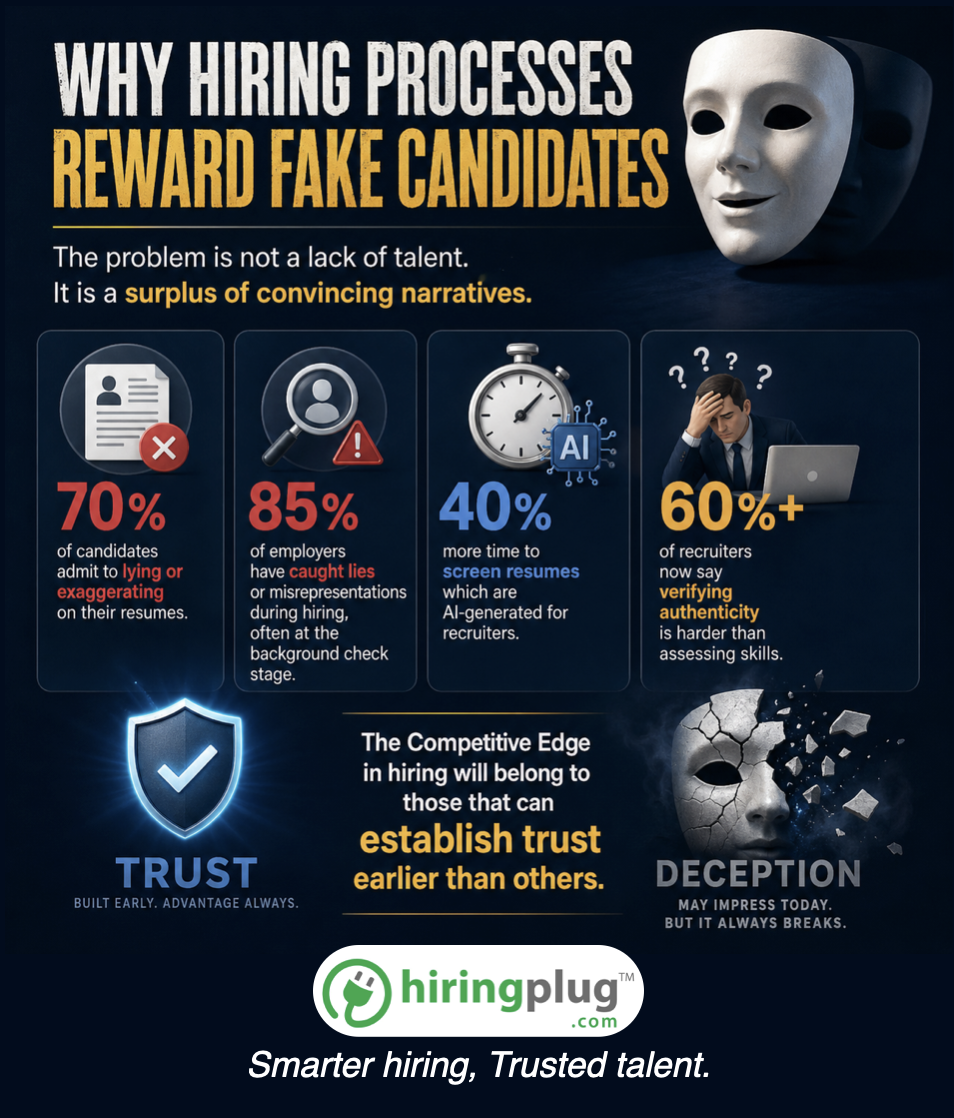
- Over 70 percent of candidates admit to lying or exaggerating on their resumes.
- Around 85 percent of employers have caught lies or misrepresentations during hiring, often at the background check stage.
- AI-generated resumes are increasing recruiter screening time by up to 40 percent, not reducing it as many expected.
- More than 60 percent of recruiters now say verifying authenticity is harder than assessing skills.
Put simply, the problem is not a lack of talent. It is a surplus of convincing narratives. The signal most teams overlook
There is a simple check that often reveals more than an entire resume review.
Open a candidate’s LinkedIn profile. Look at their activity. Compare the age of the profile with the experience they claim.
This does not prove anything on its own. A lack of online presence is not evidence of fraud. But it is a missing layer of signal, and missing signals matter.
A person with a decade of experience typically leaves some trace. Colleagues, projects, conversations, endorsements, transitions. When none of that exists, it raises a question the hiring process is not designed to ask early enough.
We still treat hiring as evaluation. In reality, it has become a problem of detection. Not just what is present, but what is absent.
Why the problem is accelerating?
- AI has made high-quality presentation universally accessible. The baseline has shifted, and what once signaled effort now often signals tool usage.
- Candidates are optimizing for systems rather than roles. When filters reward keywords, candidates produce keywords. The goal becomes passing the screen.
- And synthetic or lightly constructed identities are becoming harder to distinguish at first glance. Profiles look complete, even when they are not deeply credible.
The system, as it stands, rewards the most convincing version of a story.
There's a fundamental flaw built into the hiring funnel:
Most organizations still follow a familiar sequence. Resume screening, followed by interviews, followed by an offer, followed by background verification.
By the time verification happens, the organization has already invested time and formed opinions. Cognitive bias has set in. Narratives have taken shape.
This is reflected in the data as well. Industry benchmarks show that the majority of discrepancies are discovered only after offer stages, when the cost of reversal is highest.
Late verification does not reduce risk. It compounds it.
Verification should not be a stage. It should be a layer that runs across the entire funnel.
A different way to think about hiring: The more effective approach is not to add heavier checks at the end. It is to distribute verification throughout the process. This can be simple and practical.
- Review digital footprints early.
- Check for consistency across timelines.
- Look for publicly visible work or contributions.
- Assess how much of a profile can be independently validated.
Even small shifts here have measurable impact. Teams that introduce early-stage validation report meaningful reductions in interview-to-offer ratios and mis-hire rates, because weak signals are filtered out sooner.
Across teams that consistently make strong hires, a pattern emerges.
The best candidates are not always the most polished. They are the most verifiable.
Their experience can be traced. Their work can be seen. Their story holds together across contexts.
Organizations experimenting with this approach, including platforms like hiringplug™, are finding that candidates who pass multiple early credibility signals are significantly more likely to succeed post-hire.
It is not about eliminating risk entirely. It is about recognizing it earlier, when it is still manageable.
What this means for hiring leaders? The opportunity is not to slow down hiring. It is to become more precise earlier.
- Shift focus from speed alone to signal quality, Introduce quick credibility checks before interviews, Train teams to notice inconsistencies, not just strengths, and Track how much of a candidate’s story is verifiable.
In a market where more than two-thirds of candidates are actively optimizing their profiles, relying on surface-level evaluation is no longer sufficient.
For job seekers, t
In a market full of optimized profiles, authenticity alone is no longer enough. It must be visible and consistent.
The Competitive Edge in hiring will belong to those that can establish trust earlier than others.
The competitive edge in hiring is changing.
Curious, What is one signal you rely on that a resume cannot provide?
Hey there !
Author Details
Related Blogs



Popular Tags
Subscribe Now